Pages

Showing posts with label Vietnam. Show all posts

Ho Chi Minh City, Vietnam

Though the official name of the city was changed following the end of the Vietnam War, locals and visitors alike still refer to the city as Saigon.  Our ship was docked at Phu My, a commercial port, a 90-minute drive to this city of nine million.  We were met outside the gates by a driver and our guide, Jack.  The drive to the city is primarily through crowded suburbs but offered glimpses of the verdant countryside.

Our tour started with a stop at 2 iconic architectural landmarks, the Notre Dame Cathedral and the Central Post Office built between 1877 and 1883 by the renowned designer, Gustav Eiffel.  Jack introduced us to a local icon.  The 89-year old gentleman had worked as a scribe at the post office until 1990.  Following his retirement, he continues riding his bike (3 km. each way) and coming to "work" Monday through Friday so he can help people unable to read or write their own letters.  He has become a celebrity of sorts with people lining up to talk with him.  He is fluent in English and French, in addition to his native Vietnamese.  

The War Remnants Museum provided a graphic photographic history of the Vietnam War from the North Vietnamese (communist) perspective.  The USA's widespread use
Book sales at a street market
of Agent Orange as a defoliant and subsequent congenital defects was a major disturbing part of the exhibit.  It was a challenging reminder of that tragic part of our history.  

Our next stop was for lunch.  While the setting was rather strange, a single table with no view in the second story of a house, the food was once again varied and delicious.  Shrimp Pho Soup, Hanoi Spring Rolls, grilled steak mink, Squid roasted with salt duck, tomato sauce over pan-fried fish, shrimp fried rice, sautéed chayote squash, fresh fruit, and lotus tea completed our menu. 

Following lunch, we headed to the Buddhist temple, Thien Hau Pagoda, which is dedicated to the Chinese Goddess of the Sea, Mazu.  Intricate friezes and carved tableaus were impressive, and once again the faithful were making donations to the temple, primarily through the purchase of flowers or assorted icons.  

We ended our trip to the city with a visit to a facility which employees handicap individuals, creating artwork involving crushed eggshells finely sanded and then coated with layers of lacquer.  Many, we were told, were second or third-generation victims of Agent Orange.

American fast-food companies, large department stores, and thousands upon thousands of small businesses abound in the country.  But there is no mistaking, that in spite of the bustling capitalism on display, this is a communist country and free thought is not welcome.  

Inside the Thien Hau Pagoda 


Central Post Office

Nha Trang, Vietnam

Nha Trang is a popular seaside resort and it is easy to see why.  The extensive white sand beaches, turquoise waters framed by towering mountains is a lovely setting.  The city itself offers clean, wide boulevards, and first-class international resorts and stylish restaurants.  Historically, this was the capital of the Champa Kingdom that once controlled what is now central and south Vietnam for over 13 centuries. 

Our first stop was the temple and the white Buddha statue at Long Son Pagoda.  A climb of 152 steps takes you to the base of the Buddha and provides a great overview of the city.  Shoes must be removed before entering the temple, and an older gentleman was on hand to reprimand anyone attempting to enter with shoes.  This location was also being used by a number of beautiful young women, traditionally dressed, to create Facebook profiles. 

The Dam Market was next on the itinerary.  This 2-story complex sells local goods from foods to clothing to household goods to jewelry.  Haggling is part of the fun at the market, and initially quoted prices plummet as you walk away from the vendor. 

Next, we had the opportunity to view the city from a cycle rickshaw/pedicab.  In this rig, the driver cycles the riders around, unlike the old-fashioned pulled rickshaw of the past.  This 40-45 minute ride was a fun (occasionally scary) but interesting way to explore the city from a different perspective immersed in the chaotic traffic. 

Our day ended with a visit to the Po Nagar Cham Towers.  These Buddhist temples were built between the 7th and 12th centuries.  Temple etiquette, throughout this part of the world, dictates specific rules of dress.  Long pants and sleeved shirts are required, hats are not allowed and shoes must be removed.  At the Towers, robes were available for tourist inappropriately dressed.  We also witnessed the most generous displays of contributions from the faithful coming to pray at the temples.  Large tables of food and flowers were at the entrance and interior of the temples.  This was a perfect ending to our visit to the city.

Worshippers with offerings at the Po Nagar Cham Temple

Beachfront Nha Trang

Heading up to the Buddha 

Immersed in traffic on the pedicab


At the lower level temple of the Buddha Statue 

Da Nang, Vietnam

Da Nang's Dragon Bridge is lit at night with thousands of
LED lights.  On Saturday and Sunday at 9 PM it provides
a fire and water show. 
For this fifth-largest city in Vietnam, we opted for a private guide with a driver to explore the area.  Private tours scheduled with local companies invariably were less expensive than the large bus tours offered by the cruise ship. Considerable research prior to leaving home resulted in booking a number of such tours.  

Our female guide, Trang, was well-versed in history and culture and started our tour at the Cham Museum of Sculpture.  The statuary represented works from a 2000-year old Hindu culture that once ruled the area.  From the museum, we moved on to Marble Mountain.  This cluster of five limestone mountains outside the city features tunnels, sacred sites, and Buddhist shrines.  Mining in these sacred mountains ended quite some time ago, but marble is still widely mined in the country, and a number of shops located near the mountains, showed off the creations, from beaded bracelets to large carved lions.  

Throughout the drive, Trang pointed out the decorations being prepared for the upcoming Chinese
New Year celebration on Feb 15.  We had noticed truckloads of kumquat trees being transported and learned that every family tries to purchase one of these trees to bring their family good luck for the New Year.  Apricot blossoms in the South and Peach blossoms in the North are also important
Extensive flower display being prepared for New Year's
Celebration
purchases.  Decorations for sale along the roadways were primarily red for luck and happiness and gold for money.  Families actually start celebrating a week or two ahead of time, and then followup with another week or so after the fact, if they are able. 


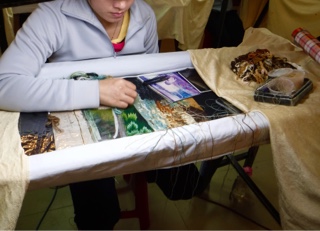
A silk embroidery shop was next on the agenda.  Displays of live silkworms, the cocoons, and an explanation of how the silk thread is made was a part of the presentation.  We found it interesting that a single cocoon yields a mile of silk thread.  Pictures embroidered by the woman are extremely detailed and an 18" X 24" piece can take 3-4 months to complete and sells for $400-600 or more depending on the amount of detail.  Of course, gorgeous lengths of silk can be purchased, or a suit or dress can be made to order. 

Next, we moved on to the ancient city of Hoi An.  This merchant riverside town is a UNESCO World Heritage site, that has remained unchanged for centuries.  Vehicles are not allowed on the narrow streets, so we set out on foot to explore.  We visited a number of old homes, most still inhabited on the upper or inner levels by heirs of the original owners.  A small entry fee to the town and various homes helps covers maintenance.  While wandering the streets, Trang led us down a narrow alley that opened to the appropriately named restaurant, "The Secret Garden".  A multi-course Vietnamese lunch followed; Tuna Soup, Crispy Fried Spring Rolls, Fish in a Clay Pot,  Grilled Chicken on Lemon Leaves, Red Hot Pot, steamed rice and fresh pineapple.  Impressive.  

Following lunch, we visited a few more homes and stopped at the Phue Kien Temple, built in honor of
Sculpture at the Phue Kien Temple
the Goddess of the Sea.  It was a full day and finally, we were returned to the ship. 
A worker at the silk embroidery shop

Sculpture at the Cham Museum

Cook at the Secret Garden

Streetfront in Hoi An

Da Nang waterfront

Street scene Da Nang

Sculpture at Marble Mountain

Ha Long Bay, Vietnam

In 2012, this bay was named one of the world's new seven wonders.  It is honored as a UNESCO World Heritage Site for its unique cultures, with floating villages and pearl farming, and unforgettable landscape, with over 2000 limestone islands jutting out of the placid waters.  In Vietnamese, the "Bay of the Descending Dragon" name comes from a legend in which a dragon spit jewels (the islands) into the bay to protect against invaders.  

Overcast, foggy and chilly weather awaited us for the day.  Knowing the day was not going to be optimal, we planned on a midday boat tour of the bay combined with a tour of one of the many caves of the area, Thien Cung or the Heavenly Palace. A visit to the cave entails climbing 120 steep steps into the cavern, considered one the most beautiful with its stalagmite and stalactite formations. Dramatic hidden caves and grottos are sprinkled throughout the islands.  Colorful junks
and hundreds of tourist-laden boats weave their way through the waters.