Pages

Showing posts with label Spain. Show all posts

Madrid Pictures

Strolling along the Seashore by Joaquin Sorolla (1909)
In the Sorolla Museum gardens.
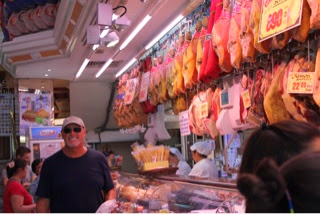
Shopping for a a smidgen of Iberian ham, Manchego cheese, and hard rolls.
One of the numerous street entertainers or mimes.
Prado Museum entrance, just before opening.
Crystal Palace, built in 1887, as a greenhouse.
Interior of the Crystal Palace
Man made pond in Retiro Park with row boats.
Fountain in Retiro Park
Incredible landscaping at one of the entrances for Retiro Park
Las Menienas by Diego Velazquez


Madrid

Arriving in Madrid, we had only a couple of days scheduled to see this beautiful city.  We were immediately blown away by the incredible architecture, the wide streets, and pedestrian walkways.  Staying once again near the city center, off of Gran Via, we were within easy walking distance to many of the city's highlights.  Our first destination, however, required a taxi.  Before arriving in Spain, Alan had voiced a desire to see the Sorolla Museum, so that was first on our list.  Joaquin Sorolla (1863-1923) was an impressionistic artist know for his use of light effects in his landscapes and portrait works but is probably best known for his Mediterranean beach scenes.  The museum is located in his former home and studio which was donated, along with many of his works, following his death.  His large studio, with a skylight, looks almost like he has just stepped out for a few moments.  A lovely garden provides the walkway to the entrance.  

Madrid is home to three world-class museums, situated closely along the Paseo del Arte, the Museo del Prado, the Thyssen Bornemisza, and the Reina Sofia.  All were within walking distance, but we ultimately decided on the Prado.  Arriving before opening time, the following day, we already had tickets in hand, which is recommended.  This massive museum displays one of the world's best collections of European art, from Bosch to Raphael and Goya to Pollock.  We also opted to see the El Greco (1541-1614) exhibit (no additional cost, but a time had to be reserved).  The exhibit is structured to show El Greco's influence on future "modernists" artists, such as Manet, Cezanne, and Picasso.  Prado is also home to what is considered to be one of the world's finest paintings, Las Meninas by Diego Velazquez.  After several hours, we had not completed the museum but decided we were too overwhelmed to appreciate it anymore.  It's definitely a don't-miss stop, just wish we had had more days to visit the other museums as well.  

Departing the Prado, we wandered into the nearby 350-acre Parque del Retiro.  Providing numerous walking paths, fountains, manicured gardens, sculptures, and a man-made pond, this is a popular place to hang out and relax.  We had been led to this place by my desire to see the Crystal Palace, which was built to house a display of flowers and plants from the Philippines in 1887.  Having seen photos of the structure, I wasn't disappointed, it's gorgeous.  I can only imagine how it looked when it was filled with colorful, tropical flowers.  Also on the ground is the Velazquez Palace, which was displaying the art of Kerry James Marshall during our visit.  His works center on African American culture and history. 

Our evenings were spent exploring the streets and plazas of the city.  Unfortunately, once again, our time was way too short for all that can be seen in Madrid, but it was a delightful visit nonetheless.  Now it's time to fly on to London, and then back to the USA.  It's been a wonderful trip in every way!


Seville

Departing Granada, we headed for a layover in Arcos de la Frontera, one of the white hill towns of the Andalucia region.  With only a street name (on the outskirts of town) for our hotel, we decided to stop at the tourist information office.  Following the signs led us to increasingly narrow streets, and finally to a single narrow lane headed sharply uphill.  Halfway up the hill we met a delivery truck coming down, someone had to back up, and it was going to be us.  After getting back down and turning around, we had no desire to go back up again.  Finding the latitude and longitude for the hotel, we programmed the GPS and arrived there a few minutes later.

Even though Arcos offers many interesting old churches and a castle from the 15th century, we decided to forego a visit to the town.  In exchange, we had a relaxing afternoon next to and in the large pool on the hotel property, which offered views of the city in the distance.  I took advantage of the downtime to contact the airline about Alan's luggage.  Several phone calls later, I discovered the bag was at the airport in Barcelona.  Providing our travel info, they promised it would be delivered to our hotel in Seville.  Hooray!  

That evening we drove into Arcos for dinner.  Checking out the menus at a few places, we decided on a restaurant that offered fresh seafood for me, and pork kabobs for Alan.  Ordering Dorado a la plancha (grilled mahi-mahi), the waiter explained, in Spanish (his only language), that they didn't have any available that evening and recommended his favorite, fresh from the sea, sepia.  Once we discussed the way it was prepared, I ordered.  What arrived about 30 minutes later was a bit of a surprise.  Looking something like a clear/whitish jellyfish with tentacles, tasting it, we both decided to forgo this entree.  Yes, we've eaten octopus, calamari and squid, but somehow we just couldn't get around the looks of this fellow.  Turns out it was cuttlefish, and we had enjoyed it before, cut up and disguised in recipes or grilled, but this blob on the plate just didn't work.  Guess it's just one of the hazards of ordering food with minimal language skills.

Arriving in Seville, we left our car at the hotel, collected Alan's luggage, and took off to explore on foot.  Once again headed into the old city center where we found the narrow roads and alleyways of the past.  Using our substandard hotel map, the tangle of streets were a challenge.  But, we managed to locate many of the city's better-known landmarks accidentally.  The Seville Cathedral, consecrated in 1507, is the 3rd largest church in the world, and the burial place of Christopher Columbus.  Alcazar, originally built as a Moorish fort, became a royal palace and continues to be used for that purpose when the Spanish king comes to Seville.  Since we had just visited Alhambra, we did not go into Alcazar, but the beautiful architecture, gardens and interior design make it one of the city's top tourist destinations.  

Seville is also known for Flamenco dancers, and we made reservations for a traditional show in a 15th-century house.  The small venue allowed us to be within a few feet of the stage.  Singing, playing the guitar and dancing are all important elements of the flamenco, which probably started as a folk dance in the 18th century combining Andalusian and Romani (gypsy) influences.  The male and female dancer displayed different styles, which is typical, the singer was passionate in his presentations and the guitarist displayed great flair; they all put a lot of energy into the show.  We were so close, we could actually feel the whoosh of wind as the dancer swirled her skirt, we both thoroughly enjoyed the show. 

The next day, we decided to visit the 100-acre Maria Luisa Park and Plaza de España.  Formally the gardens for the Palace of San Telmo, the property was donated to the city in 1893 for public use.  In 1929, the Plaza de España was built on the edge of the park for the Ibero-American Exhibition World's Fair.  The buildings are now used for government offices, but the gardens, fountains, ponds, and lush plantings make this not only a beautiful retreat but provides a great place to hang out in the heat.  We spent the remainder of the day wandering about the city and getting a little lost.  Now it's time to move on to Madrid.


Granada, Spain

Before traveling to Spain, we had read, and been told, that we could not visit the country and miss Granada and the Alhambra Palace.  Heading into the center of the old town, Alan wove down the narrow streets missing pedestrians oblivious to the cars, and buildings unnervingly close.  Happy to arrive at our hotel, and abandon the vehicle for a couple of days, we went out to explore.  Ready for some lunch, we wandered into a nearby restaurant displaying dozens of Iberian and Serrano hams from their ceiling, combining decorative theme and inventory storage in one fell swoop.

Iberian hams are a type of cured ham that comes from the black Iberian pig, raised primarily in southwestern Spain.  There are a few varieties depending on the exact type of feed the pig receives, but the most expensive hams come from animals that are fed acorns, just before they go to market, and are cured for as long as 48 months.  Obviously, not your grocery store variety of ham.  Online, I found a 4.5-pound ham for only $240., such a deal!  Serrano hams are derived from white pigs and are cured for only 6-18 months.  They are not as fatty as the Iberian ham, and not nearly as expensive.

Boarding a small bus at Plaza Nueva, for a 1,20 euro each, we rode to the top of the hill and were treated to great overviews of the city and the Islamic castle, Alhambra.  Then, we took a second bus from the same plaza, offering a different route, but still providing views of the castle and the city.  This probably saved us about 3 hours of walking, a lot of it uphill, in the 98-degree heat, so we thought it was a good deal.  Riding the bus is a different experience in the old city.  We were amazed at the way the drivers maneuvered through the narrow streets, seemingly inches from the walls as they took corners, or backing up when there was a conflict with another vehicle.  Incredible job!

Walking through the old town, vendors sold a bit of everything, not exactly the markets of Marrakesh, but a little taste of it.  Planning to visit Alhambra, we had made online reservations a couple of days earlier, which is okay during their slower summer season.  We spoke with a few people who had gotten shut out of the visit by not realizing the need to plan ahead.  During their busier season, it can take 2 weeks or more to get tickets, and you have to select a specific time for the visit to the Palace Nazaries. 

Originally built as a military area, the Alhambra became the home to royalty.  Starting in 889, a small fortress was built on the hill on the outskirts of the city.  In 1237, a Moorish king, Muhammad I. Al-Ahmar, of the Kingdom of Granada rebuilt and renovated the structure to the size which exists today.  An assortment of Muslim rulers made additions and improvements within the walls over the next two hundred plus years.  Then in 1492, King Ferdinand and Queen Isabella further altered the palace after their conquest of the city.  In 1527, Charles V, Holy Roman Emperor, had another palace built within the walls of the fortress.  With each new ruler, the property was further enhanced and is now a UNESCO World Heritage site and a major tourist draw.

The fort, palaces, gardens, and grounds of Alhambra are extensive.  With our 5:00 PM ticket to enter the Palace Nazaries, we were allowed to enter the grounds of Alhambra at 2:00 PM, we left around 7:00 PM, and we hadn't seen it all.  Heat and exhaustion ultimately won out.  Alhambra has been the inspiration for many stories, poems, and music throughout history.  The beauty has been tarnished by age, vandalism, war and an earthquake, but the beauty still manages to shine through.

Next, we are moving on to Serville.
Granada photo link.


Granada and Alhambra Pictures

Iberian and Serrano hams decorated the restaurant.
Cathedral at Plaza Nuevo
Granada Cathedral located just off the old city center, started in 1518, finished 181 years later.
Spices and teas for sale along the walkway.
Alhambra as seen from our bus ride.
View from the Vela Tower overlooking the fort.
City of Granada seen below the palace, through some windows.
In Palace Nazaries, looking out to some gardens.
In the Palace
Inside Charles V Palace
At Palace of the Partal
Walls in the palace
Near the Patio of the Lions
Sunflowers grown on countless large plots on the route to Seville.
Olive groves (in between the sunflower plots) on the route to Seville, miles of olive trees.


Seville Pictures


Arcos de la Frontera
Flamenco dancers and singer, guitarist hidden behind the dancers.
Seville Cathedral
Seville Cathedral
Torre de Oro
 Metropol Parasol near the old city finished in 2011, contains a museum, a market and restaurants.
At Plaza de Espana
Plaza de Espana
Plaza de Espana
Palace of San Telmo
Some of the streets covered with fabric, help keep down the heat which stayed in the upper 90's
Roman columns
Photo of Guadalquivir River at night.


Sagunto Castle and Theater and Manzanno Beach Pictures

Walking through old town Sagunto
Overlook from the top.
View of town and Cathedral from the Castle.
Walls of the fortress.
Near the site of the Roman forum.
Entryway to the fortress.
Mile after mile of orange trees.
Rehearsal at the Roman theater.
Fight scene in the rehearsal
Along Manzanno beach.
Sunset at Manzanno beach