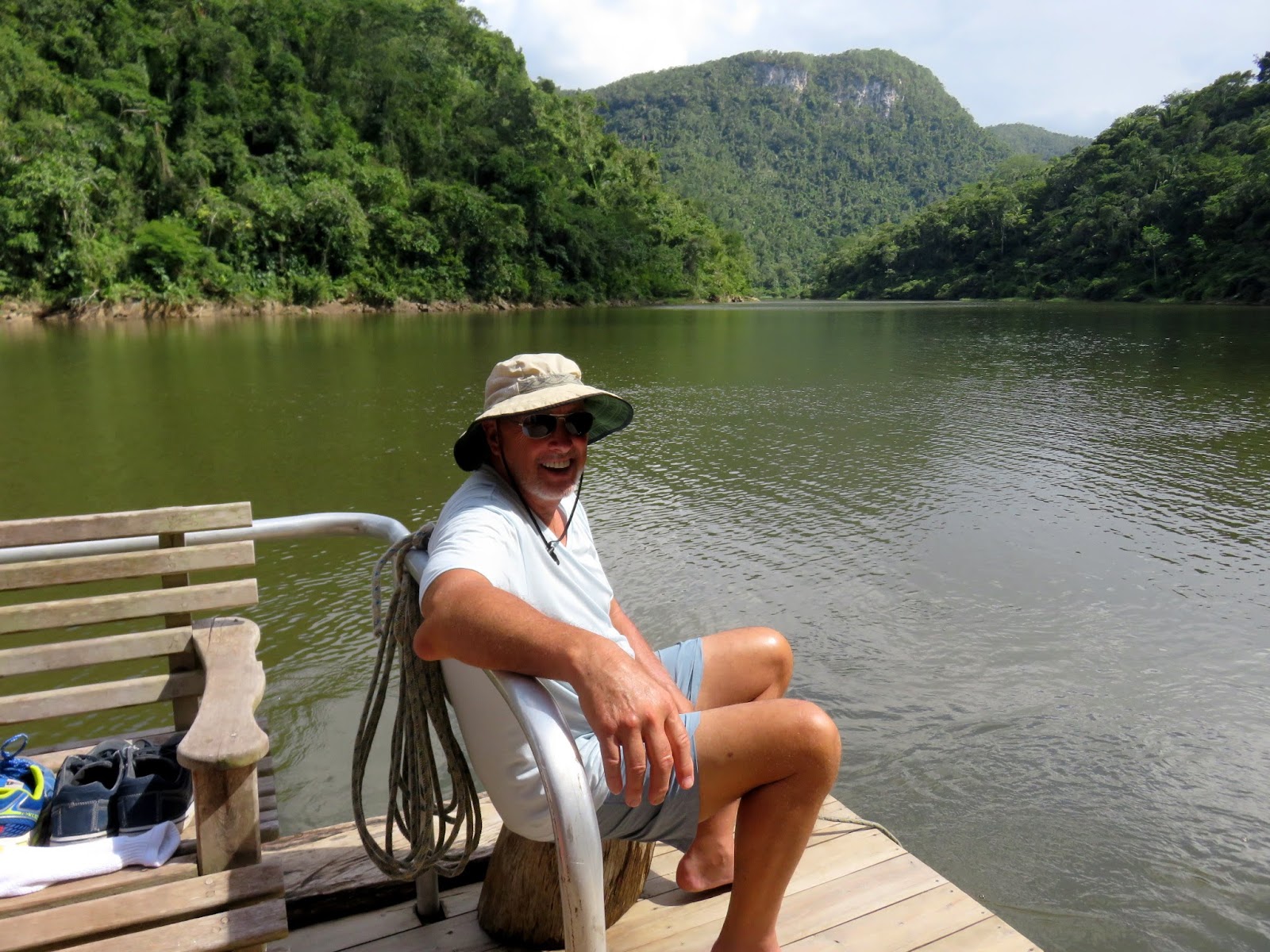
The following morning we boarded a 20-passenger bus offered by Marlin Espades to Belize City, where we changed buses and traveled on to our final destination San Ignacio at $35 pp total. Visiting Alan's sister, Diane and her husband, David, in nearby Bullet Tree Falls was the reason for our trip. We spent our time hanging out, eating, talking, and more eating. Diane had stocked up on local seafood brought in from the coast, so we indulged in conch, lobster, hog snapper, and yellowtail, and we visited the produce market to load up on fresh veggies and fruit. Gourmet dining every evening!

Taking advantage of the fact we were already in Belize, we decided to travel to Caye Caulker. Traveling back to Belize City, we then caught a 45-minute ferry over to the island. Two ferry companies run several trips a day at $25 for a round-trip ticket. Though seats are generally available, it's a good idea to purchase tickets prior to your travel date to ensure a seat especially on weekends or holidays (and note Belizean celebrate different holidays, so research that before your travel).
Having located a room on Airbnb, we were located near the ferry, the center of town and with a waterfront view. We also had a partial kitchen and AC. Air conditioning is something that cannot be taken for granted. Most accommodations on the island do not offer it, saying you won't need it because of the prevailing onshore winds. But when it is 90 plus degrees with a heat index of 100 (as it was during our visit), you will be grateful to have upgraded to a property that offers the AC. Caye Caulker is a relatively tiny island, roughly 5 miles long and less than 1 mile wide. Walking around the island is fairly easy, if centrally located, but bike and golf cart rentals are also available. Deciding to splurge on a cart rental, we enjoyed buzzing around the island and at the same time creating our own breeze. We spotted a handful of commercial vehicles but no cars are allowed on the dirt roads. A few blocks along Main Street are closed during the evenings to reduce dust, created by the carts, from flying into restaurants.
Our first evening, we followed the recommendation of some folks we met and ordered beef and cabbage tacos with
salsa offered a street stand along Main Street. Three hearty tacos sold for $5 Belize (or $2.50 US). Throughout the country, US dollars are widely accepted, in fact, it is generally preferred. The street exchange rate is 1 USD equals 2 BZD, but if you pay in US dollars you will receive Belizean money in change, just something to keep in mind as your trip is drawing to a close--unless you want to take some foreign monies back home as a souvenir.
Since the island is known for snorkeling, we scheduled a half-day tour with Caveman Tours, though there are at least a dozen companies offering snorkel/dive, land tours or fishing trips. Traveling out to the Hoi Chan Marine Reserve, we had brief stops to hand feed sardines to tarpon and then to a seahorse sanctuary. Unfortunately, the constant 15-20 mph winds which had preceded our visit created cloudy conditions with silt covering the coral at the Coral Gardens. Moving next to clear, relatively shallow waters where, according to our guide Ronnie, fisherman have historically stopped to clean their fish. Because of this activity, rays and nurse sharks are attracted when they hear boat engines. Swarms of both sharks and rays surrounded the boat on our approach. While both are, for the most part, harmless the sharks do have thousands of tiny serrated teeth and they will bite if aggravated, so Ronnie recommended we not get too close. Feeding sardines to the throngs kept them near the boat as we snorkeled over, under and through them. Finally, the boat moved closer to the outer reef. Ronnie swam ahead of us diving down periodically to identify the variety of corals and fishes. During our visit, there were few tropical fish seen but numerous snappers and a nice variety of coral. Diving is popular in the Reserve, so perhaps that offers a more colorful experience.

The Split, located at the north end, divides the island in two. The property at the tip is managed by the Lazy Lizard Bar and Grill, a popular tourist haven, with loud music, cocktails, beer, and a bar menu. But, the waters at the Split offers visitors an opportunity to snorkel free rather than pay for an offshore tour. Coral is non-existent here but an assortment of fish can be seen, especially near the mangroves on the bayside. Snorkeling earlier in the day is recommended, particularly on weekends, when the Lizard starts drawing a crowd. Currents can be strong though and boats moving through the Split offer another possible danger, so caution needs to be used if swimming/snorkeling across to the island and mangroves on the opposite side. The only two public beaches we found were located near the Split. One was on the ocean side along the sea wall, with entry via metal steps or a diving platform. Currents on the oceanside were very strong during our swim here, so we weren't tempted to explore. The other location was a small sandy beach on the bayfront, crowded with locals on the day we stopped for a swim to cool off. Finding a few palm trees to provide shade, we listened to the reggae music being played by the DJ and enjoyed the breeze. Lizard customers have access to wooden boardwalks offering entry to the water, and even a few tables with palm-thatched covers located down inside a cove.
Over the next few days, we explored the island multiple times, tooling around in our cart. We located the bakery,
multiple grocery and convenience stores, the produce market, and a tortilleria (for freshly made tacos). The tacos were made in a little wooden shack located not far off Main Street. If the wooden window was propped up, she was open for business, 6 hot, fresh off the grill tacos went for 1BZD. Though we wound up eating most of our meals at the local restaurants, and there are plenty of places to choose from, we also prepared red snapper with a garlic, lime butter sauce, that competed with anything we ate out.
Returning to Belize City on an early morning ferry, we were able to easily score a taxi for the ride to the International airport, a 30-minute drive away and a flat-rate $25 USD fare. It was a long but uneventful travel day, and we are now back home, at least for a bit.
 |
| At the outer reef |
 |
| Laundry day in Bullet Tree Falls |
 |
| Along Main Street |
 |
| Along Front Street |
 |
| Produce market in San Ignacio |
 |
| Laundry day on Caye Caulker |
 |
| Bay side |
 |
| Volleyball tournament at the Lizard |

 One slight miscalculation had us arriving in Chetumal on a Sunday. In resort areas that is not a problem--in this non-tourist oriented city, almost everything was closed down for the day. Luckily, the hostess at our hostel was able to direct us to an open restaurant, Marisqueria Mi Viejo, roughly a one-mile walk away, though taxis are dirt cheap as well. The restaurant was packed and we were definitely the only gringos on hand. The generous dinner was tasty and inexpensive, and the meal was enhanced by a live band with a talented vocalist, so it was an authentic Mexican experience.
 salsa offered a street stand along Main Street. Three hearty tacos sold for $5 Belize (or $2.50 US). Throughout the country, US dollars are widely accepted, in fact, it is generally preferred. The street exchange rate is 1 USD equals 2 BZD, but if you pay in US dollars you will receive Belizean money in change, just something to keep in mind as your trip is drawing to a close--unless you want to take some foreign monies back home as a souvenir.
 multiple grocery and convenience stores, the produce market, and a tortilleria (for freshly made tacos). The tacos were made in a little wooden shack located not far off Main Street. If the wooden window was propped up, she was open for business, 6 hot, fresh off the grill tacos went for 1BZD. Though we wound up eating most of our meals at the local restaurants, and there are plenty of places to choose from, we also prepared red snapper with a garlic, lime butter sauce, that competed with anything we ate out.