Pages

Showing posts with label California. Show all posts

Mendocino and San Francisco

Several months ago, Alan was perusing the internet for "Plein air" events around the country.  Submitting an application for the Mendocino Open Paint Out (MOPO) was easily completed but as the event approached we hadn't decided if we wanted to make the trip or not.  We've traveled through Mendocino a few times through the years, but did we want/need to make the trip again?

Formerly a logging town, the active artist community, with a population of 900, is perched along
rocky cliffs overlooking the Pacific, but that in itself was not reason enough to make the trip.  Perhaps, the Florida heat was the deciding factor.  Looking at the forecast for northern California, it appeared that temperatures would be substantially cooler than home.  Locating a reasonably priced 1-bedroom house on a rural property in nearby Little River on Airbnb was the second part of the equation.  Being able to book the flight using air miles clenched the deal.  So we were California bound!

Arriving a day before the event started, we were able to visit nearby towns and parks so Alan could decide on painting venues for the week.  After getting his papers stamped the following day, we were off to his first destination, an old
house near Mendocino Headlands State Park which wraps around the waterfront.  Over the next week, we traveled to Van Damme SP, Russian Gulch SP, Jug Handle State Reserve, Noyo Headlands and Marina, Big River SP, Greenwood State Beach, and Point Cabrillo Light Station and countless unnamed coves and overlooks as Alan painted and I snapped photos.  Perfect weather, or our interpretation of perfection, followed us for the entire week.  Temperatures ran between 70-75 during the day and 55 at night with light breezes and sunny skies.

Intrigued by the water towers dotted around Mendocino, I spent hours walking through town
documenting the structures.  Built at the end of the 19th century, the towers have provided residents and local businesses with water.  Historically, windmills were used to pump the water up to the towers.  Some of those are still standing, but electricity now pumps the water from the shallow water table to the towers, which then use gravity feed systems.  The town still has no central water supply, so many towers are still being used, but several have been converted into cozy dwellings, some of which are available for overnight guests.  


The 50+ participating artists for MOPO hung their works at the end of each day at the Mendocino Art Center.  Daily viewings were offered, and the week culminated with awards on Friday and a "quick paint" event on Saturday.  Music and locally produced wines were offered at the closing on Sunday.

Heading off the next day, we meandered through the Anderson Valley wine region, stopping for an occasional tasting, as we drove to San Francisco for the final day of our trip.
Old barns on newly acquired State-owned lands
Alan's rendering of the barns


San Francisco In 36 hours

Entering the City over the Golden Gate Bridge.
Interior San Francisco Museum of Modern Art

Produce market along the waterfront

Coit Tower opened in 1933

View of harbor with Alcatraz in the background
City's popular cable cars

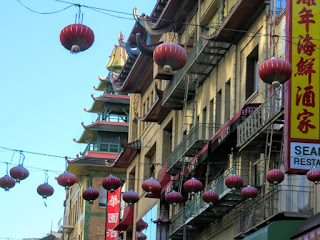
Walking through Chinatown

Transamerica Pyramid built in 1969

Kings Canyon National Park

-->
Arriving in Kings Canyon, without reservations, we lucked into a roomy corner site at the Grants Grove Azalea Campground.  None of the sites offer electric and water, so we knew we would only be able to stay 2 nights with our generator not recharging properly.  Also, we learned that the Hwy. 198, going south through Sequoia National Park has a vehicle length limit of 22 feet due to the extreme curves on the road.  Our RV is 26 feet long without the Honda attached to the rear.  So, we had a little change of plans, Sequoia was
General Grant Tree
eliminated as a destination.

Driving initially into the General Grant Grove, we meandered, once again, along the trails and through the giant sequoias.  The General Grant Tree is the star.  It is considered to be the 3rd largest tree in the world, with a circumference of 107 feet and height of 267 feet.  Pretty impressive!  This trail was not as crowded as the walks we had completed at the Mariposa Groves in Yosemite, but the tree is one of the biggest draws in the park, so we were lucky to find it relatively quiet. 

Heading next up to Panorama Point, at 7500 feet we enjoyed a spectacular view of the canyon and the distant Sierra Nevada Mountain range.  With a limited time frame for our visit, we decided to head down into the canyon.  Fantastic views and multiple stops for overviews falls and short hikes filled our day. 
Overview of the drive with darkening skies

With skies darkening and the temperature dropping as we returned to camp, we decided to forgo our campfire (allowed above 6,500 ft.) for the evening.  A few minutes later, dime-sized hail was pounding away on our metal home and heavy fog reduced visibility to a few feet.  Since the park has had a serious drought problem, the downpour was a positive thing.  Through the evening the hail/rain stopped but temperatures continued to drop.  We awoke to frost on the ground and our vehicles.  Brrrrr, with the heater not working, we packed up and moved south again.  Surely, there will be no frost in Las Vegas.
Zumwalt Meadows

In the Cedar Groves

Alan with giant sequoia

Driving down into the Canyon


Along the drive


Along the Canyon floor

Alan at Roaring River Falls
Western gray squirrel, caught by Alan


Yosemite National Park


Half Dome- the iconic Yosemite symbol
In 1864, President Lincoln declared Yosemite Valley and the Mariposa Grove of giant sequoia a public trust.  This action was taken to prevent the commercial exploitation of the lands.  It was the first time the government had moved to protect land for the public and formed the basis on which the National Park system was later established.  In 1890, Yosemite became the country’s 3rd national park.  Even though the park covers 1169 square miles, with roughly 4,000,000 visitors each year, the park can become quite congested in the Valley and Mariposa Groves. 

Over the past few weeks, we have monitored the most recent Yosemite fire closely.  Started on
El Capitan on the left, Three Brother on the right
August 17th to date, it has burned 401 square miles (not all within the park borders) but the fire is now 84% contained and recent rain has helped.  Webcams at different locations in the park and online reports allowed us to make the decision to go into the park.  Entering the park from the south, near Fish Camp, and spending most of our time in Yosemite Valley, the fire did not affect our visit at all.  Campgrounds were full and all of the venues we visited were busy.

In the Mariposa Grove
The Park Service has instituted the use of a shuttle system to transport visitors to the popular Groves once the parking area reaches full capacity.  Private vehicles are still allowed through the rest of the park, but the best way to see the park is to get out and hike the many trails.  With 800 miles of trails, there are plenty of options. 

Through the Valley, there are a number of short, relatively level hikes.  One of the most popular hikes out of the valley is the Vernal Falls Mist Trail.  Rated
Vernal Falls- 317 feet on the Merced River
as moderate to strenuous, this round trip hike can take 3-4 hours if you’re in good shape.  Forty years ago, I hiked that trail and enjoyed a picnic lunch at the top.  This visit, we viewed the falls from the vantage of Washburn Point.

For the more adventurous at heart, Half Dome and El Capitan offer a greater challenge.  Half Dome is the most dangerous and arduous hike.  There is a 4,800 feet elevation gain from the Valley: and it’s 8,842 feet at the top.  Lotteries are now used to select the 225 hikers per day to receive the permits required for the hike.  The hike can only take place when cables are up, between mid-May to October, depending on the weather.  For most climbers, this provides a 10-14 hour hike (depending on the route selected and abilities).

El Capitan- a 3000-foot granite monolith
El Capitan, on the other hand, is the largest monolith in the world, and a popular and challenging climb for those with the skill to tackle it.  During our stay, we watched 2 climbers scaling the sheer side, unbelievable.  This is NOT on our bucket list.

With our generator failing to provide our power, and ultimately, even our water, it was time to move on.  Heading south.

Climber moving up El Capitan

Blacktail deer in Yosemite Valley

Alan at Washburn Point

Cathedral Peak

Nevada Falls- 594 feet

View from Glacier Point

View of the Valley from Glacier Point

Alan painting at Glacier Point

Coyote posing for picture

Artist at work


Giant sequoias grow to over 300 feet, live up to 3200 years, have a base up to 40 feet diameter, and bark up to 31 inches thick.  They grow only on the Sierra Nevada's western slope.