 |
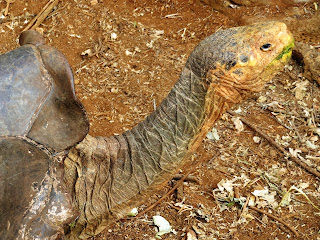
| Diego |
Returning to Santa Cruz, we were visiting the inhabited portion of the island, and traveling to the Charles Darwin Research Station. Scientists work at the facility on research and conservation projects for the Galapagos ecosystems. The Charles Darwin Foundation, located at the site, operates an active turtle and land iguana breeding program. Lonesome George, the world's most famous Galapagos tortoise died in 2012, the lone survivor of his species. Diego, the world's second most popular tortoise resides at the Station. Still going strong at 135 years old, it is estimated that he has sired over 1700 young. He happily dedicated himself to the survival of his species, the Espanola tortoise, but was put into retirement 4 years ago.

Departing the Station, we headed up into the highlands to Rancho Primicia. At over 150 hectares, this private property borders National Park lands, and wild Galapagos tortoises find their way to the ranch to lounge in mud pools and hang out in the shade. Dozens of the huge reptiles were spotted during our visit. For those of our group so inclined, empty tortoise shells could be donned, we declined that opportunity. Numerous lava tunnels exist on the island, and we had a chance to walk in one on this same property. Lighting in the 1000 foot tunnel was installed by the owner. The furthest depths require a flashlight, and hands and knees exploring. They are formed when cooler outer parts of the lava flow harden into thick rock walls, providing insulation to keep a flow going inside. Eventually, the flow
subsides leaving long empty tunnels. No volcanic activity has occurred on Santa Cruz in thousands of years, so no worries about anything happening during our visit.
Returning to town, we did some souvenir shopping and hanging out along the waterfront before returning to the Letty for our last evening in the Galapagos. The following day, we visited the Environmental Interpretation Center in San Cristobal that provides info on the history, biology, and geology of the islands. We also saw dozens of sea lions before meeting our guides for the bus trip to the airport for a flight to Guayaquil and then on to Peru.
 |
| Santa Cruz waterfront |
 |
| At the fish dock along the waterfront in Santa Cruz |
 |
| Opening of the lava tunnel |
 |
| Heron at Rancho |
 |
| Doing their part to perpetuate the species |


